Why Woven Ribbon Has Two Selvage Edges
Why woven ribbon has two selvage edges: see how the loom turns yarns at each side into a finished boundary that helps the strip resist unraveling.
Woven ribbon has two selvage edges because its crosswise yarns turn back at the sides instead of ending as loose fringe. That small construction detail helps explain why woven ribbon can be cut from a narrow strip and still hold together in use. The edges are not separate binding; they are part of the weave.
What does a selvage edge do?
A woven fabric is made from two sets of yarns. The lengthwise set is called the warp, and the crosswise set is called the weft. On a loom, the warp runs along the ribbon’s length while the weft passes from side to side, interlacing with it.
At the ribbon’s edge, the weft changes direction and returns across the warp. The resulting turn forms a narrow boundary along each side. These boundaries are the selvages, also spelled selvedges. On a narrow woven ribbon, they usually run continuously from one end of the roll to the other.
Think of the edge as the turned end of a stitched line, rather than a hem added afterward. The comparison is not exact, but it captures the essential point: the yarn that reaches the side does not simply stop there.
How does the loom form both edges?
As the loom builds the fabric, it repeatedly sends the weft across the warp. At one side, the weft loops around the outermost warp yarn; it then travels back through the next opening in the weave. At the other side, it makes a corresponding turn. Repeating those turns creates two continuous edges.
The loom’s arrangement determines how the weft is carried across and returned. Narrow fabrics may be woven on equipment designed to produce several ribbons or narrow strips, with each strip formed as its own woven length. The details vary by loom and construction, but the principle remains: the side boundaries are made while the body of the ribbon is being woven.
This is why a woven ribbon’s edges can look slightly different from its center. A selvage may be denser, thicker, or more cordlike, depending on the yarns and weave. That difference is not automatically a defect. It often reflects the turns needed to keep the edge connected.
Why can a finished edge help the ribbon hold together?
The returned weft yarns give the side a connected structure. They reduce the chance that the crosswise yarns will simply slip out at the edge, as they might from a raw cut through the fabric. The warp yarns also remain interlaced with the returning weft, so the edge is joined to the ribbon’s woven body rather than attached as a separate layer.
That construction helps woven ribbon tolerate ordinary handling, such as tying, folding, and passing through a slot. The edge is not indestructible: sharp abrasion, a snag, or repeated stress can still distort yarns. But a woven selvage gives the strip a more stable boundary than an unfinished cut edge.
It also helps explain why ribbon can be cut across its width without the long sides immediately opening into fringe. A crosswise cut severs some lengthwise warp yarns at the ends, so those cut ends may fray. The selvages run along the sides, not across the cut ends, and therefore do not seal every possible edge.
How can you tell a selvage from a finished cut edge?
Look along the long sides of the ribbon. A woven selvage often appears as a continuous, compact line, sometimes slightly raised or tightly packed. The two sides may resemble each other, though small variations can occur.
Then inspect a short end. If the ribbon was cut from a roll, the end may show tiny yarns or a tendency to loosen. A manufacturer may finish that end by heat, stitching, or another method, depending on the material and product. Those treatments are distinct from the selvage formed during weaving.
For a simple check, use a magnifier and follow one crosswise yarn near the side. In a woven selvage, it should turn around the edge and return into the fabric. A coating or folded edge may look neat too, but its appearance alone does not show that the boundary was woven in.
What questions help identify woven ribbon edges?
Do all woven ribbons have selvages?
A woven strip generally has a formed boundary along each side, but the appearance and strength of those boundaries depend on its construction. Some ribbons have clearly visible, firm edges; others have edges that blend into the body.
Are selvages always the same on both sides?
They are made by corresponding turns at opposite sides, but they need not look identical. Loom setup, weave structure, and yarn behavior can make one edge appear tighter or more pronounced.
Does a selvage stop ribbon from fraying everywhere?
No. The selvage protects the two long sides by keeping the woven structure connected there. A cut end crosses the warp yarns and may still fray, so the side edges should not be mistaken for a finish on every edge.
Can a ribbon edge be woven and still be damaged?
Yes. A selvage is part of the fabric, not armor. A snag can pull a loop out of place, and sustained rubbing can wear yarns down.
What changes the look and behavior of a selvage?
Yarn thickness, weave structure, and the way the weft turns all affect the finished side. A tightly packed edge may feel firmer than the ribbon’s center, while a softer yarn can make the boundary less distinct. The face of the ribbon may also make the selvage easier or harder to see, but surface appearance alone does not determine whether an edge is woven.
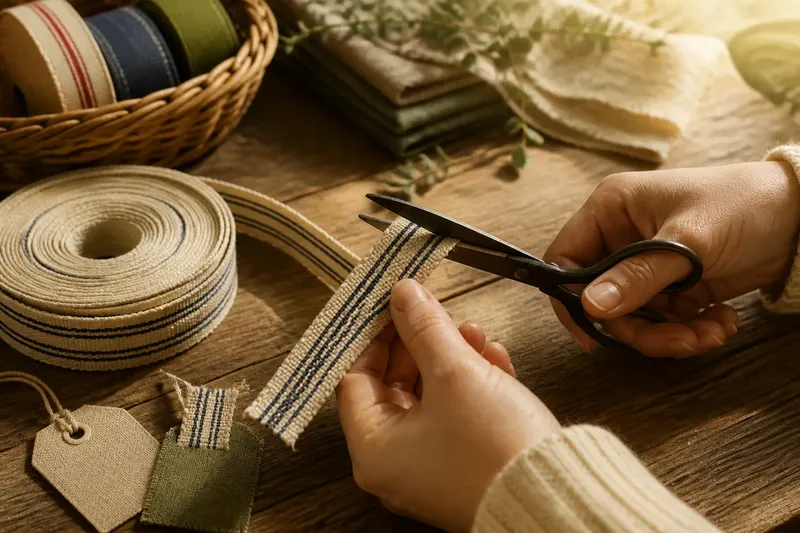
Imagine a person cutting a length of woven ribbon for a fabric tag. The long sides remain intact because their weft turns are still connected to the warp; the newly cut ends may show loose yarns. If the person notices that difference, they can treat the ends separately without trying to seal the already-woven sides.
Why does the construction matter in everyday use?
A selvage gives designers and makers a ready-made long edge. It can remain visible on a narrow trim, pass through a buckle or guide, or sit against another material without needing a folded hem along both sides. That can be useful in clothing details, packaging ties, and decorative work where a clean strip matters.
It also provides a practical clue when choosing or handling ribbon. If a project depends on a crisp side boundary, inspect the edge itself rather than judging only the face. If the ribbon will be cut into short pieces, consider how the cut ends will be finished; the woven selvages cannot do that job for them.
Understanding why woven ribbon has two selvage edges makes the strip easier to read: the long sides are formed as the loom carries the weft back and forth, while the ends are created later by cutting. Treat those as different boundaries, and it becomes clearer which edges can be left as woven and which may need attention.