From Loom Decoration to Gift Finishing: A Brief Ribbon History
Ribbon history follows a useful shift from woven clothing trim to trade good and gift finish, showing why one origin cannot explain every tradition.
Ribbon history is not the story of one invention spreading everywhere. It is a record of a narrow woven strip serving different jobs: edging clothing, displaying wealth, moving through trade, and finishing a parcel. Its uses changed as textiles and habits changed, while local traditions kept their own meanings.
What counted as ribbon before the gift bow?
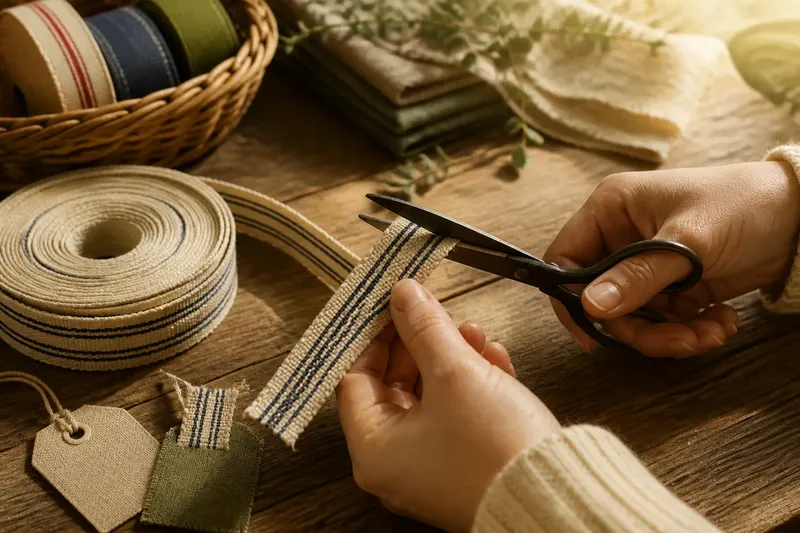
Before ribbon became a familiar feature of gift wrapping, narrow bands of woven material had practical and decorative work to do. They could bind an edge, secure a garment, reinforce a seam, or add a visible line of color. A strip of cloth is modest in scale, but it can alter the appearance of a whole sleeve or hem without requiring a large quantity of expensive fabric.
In clothing, narrow woven trim offered a way to mark a garment’s finish and, in some settings, its owner’s means or taste. The value lay not only in the fiber but in the labor of weaving, the color, and the difficulty of obtaining a particular material. Silk ribbon, for instance, could be more conspicuous than a plain linen tie, while a less costly band still supplied useful structure or contrast.
These functions did not form a universal sequence. Different communities made and used narrow bands according to local dress, available fibers, and craft traditions. Some strips served chiefly as ties; others were applied as ornament or woven into a larger textile. Calling all of them stages in one ribbon story would make the history tidier than the evidence permits.
How did ribbon become a trade good?
Narrow woven goods suited trade because they could be made in varied colors and patterns, stored in compact form, and sold by length. Weavers, merchants, and retailers could offer trim without selling an entire garment. For the buyer, a small purchase could refresh clothing or provide a finishing detail without replacing the cloth beneath it.
As specialized weaving developed, ribbon could be made as a distinct product rather than simply cut from broader fabric. Looms designed for narrow work helped produce repeated bands efficiently, including multiple lengths at once. That development belongs to a broader history of textile production: machinery and skilled labor changed what could be supplied, but did not erase hand production or local methods.
Trade also widened the range of materials and styles available in particular markets. Silk, cotton, wool, and later manufactured fibers each brought different qualities and costs. Retailers might sell ribbon for dressmakers, milliners, household decoration, or personal use, so the same roll could move between purposes. The counter was not a border between clothing and decoration; it was where those uses met.
Why did ribbon settle so firmly into clothing?
Ribbon’s place in clothing came from its combination of finish and flexibility. It could edge a cuff, mark a waist, tie a bonnet, or provide a contrast against a plain garment. Unlike a fixed embroidered motif, a ribbon could sometimes be replaced, rearranged, or transferred to another piece. That made it both ornament and a practical component.
Fashion altered the visible roles of ribbon. When clothing favored elaborate surfaces, trim could become prominent; when simpler silhouettes gained ground, a narrow tie or restrained edging could still remain useful. The material did not disappear whenever its decorative prominence receded. It shifted toward smaller applications, accessories, and domestic work.
Ribbon could also carry social signals, though those signals were never stable everywhere. A color, placement, or quality might suggest formality, affiliation, mourning, courtship, or simple preference in a particular setting. The same color could mean something else elsewhere, or nothing beyond the wearer’s taste. A ribbon is closer to a note pinned to a coat than to a fixed dictionary entry: its meaning depends on who sees it and where.
How did ribbon move from clothing to gifts?
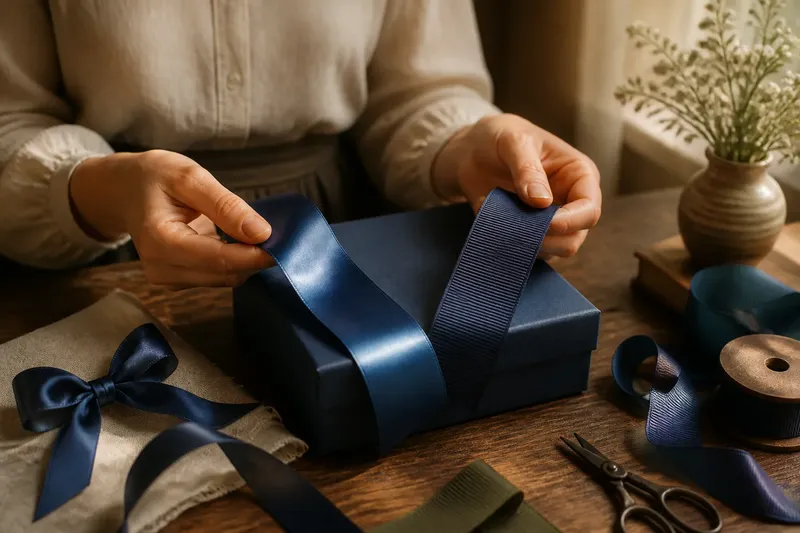
Gift presentation drew on skills and materials already familiar from clothing and household decoration. A ribbon could close a parcel, cover a join, or add a deliberate finish. As wrapping practices developed, the ribbon’s visible role grew: it did not merely hold the package together but helped signal that the contents had been selected and prepared for someone.
The shift was gradual and varied. Gifts had long been carried, contained, or presented in many ways, and no single wrapping custom can claim ribbon as its starting point. Paper, boxes, fabric, cord, and decorative bands entered different traditions through different routes. Ribbon became especially convenient where a soft tie could gather paper around a package and where a bow or loop made the closure easy to recognize.
Commercial gift wrapping helped make the finished parcel a familiar retail object. Shops could offer paper and ribbon as part of presentation, while householders adapted the materials to their own habits. Ribbon’s role changed from an element attached to clothing to an element attached to the package, but the underlying appeal was similar: a narrow, visible strip could make an edge, fastening, or transition look intentional.
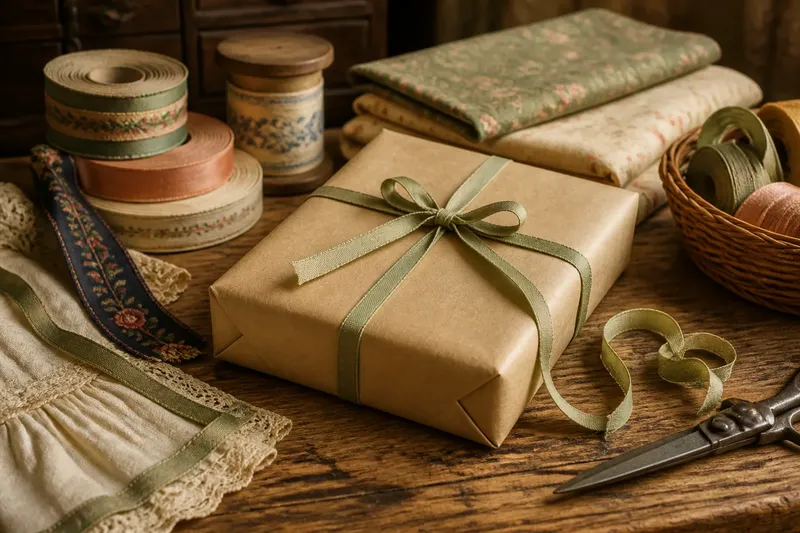
Say a shopkeeper in an invented scene has a plain paper parcel and a length of cotton ribbon left from a clothing order. She ties the ribbon around the parcel rather than adding a large decoration; the observable result is a package that stays closed and looks finished, while the ribbon’s earlier association with textiles remains visible in its use.
What changed as gift presentation became routine?
Once ribbon was used regularly on parcels, its materials and finishes broadened to suit new expectations. A sturdy cotton tape could be reused or serve as a firm tie; a smooth synthetic ribbon could hold a crisp loop; a narrow metallic-looking trim could provide a brighter accent. These choices were not simply a march toward more elaborate wrapping. They reflected different priorities, including cost, appearance, availability, and whether the ribbon was expected to be kept.
Reusable ribbon also complicates the idea that gift trim is disposable decoration. A recipient might save a sound length for sewing, another parcel, or a household project. In other cases, ribbon became part of the gift itself, especially when attached to clothing, flowers, or a keepsake. Its purpose therefore depended on how the giver and recipient treated it, not only on its position around the package.
Retail packaging and mass production made ribbon easier to encounter, but they did not make it culturally uniform. A bow on a present can suggest care in one context, ceremony in another, or merely a familiar finishing habit. The shape alone cannot settle its meaning; the object, occasion, and local practice matter.
What questions help explain ribbon history?
Did ribbon begin in one place?
No single origin explains every narrow woven band or every later ribbon custom. Communities developed textile ties, trims, and decorative strips in different ways, so a broad history should distinguish related practices rather than assign them one birthplace.
When did ribbon become a gift decoration?
There is no universal moment when ribbon moved from clothing to packages. Gift presentation developed through local customs and changing retail practices, with ribbon adopted where it suited the materials and expectations of the occasion.
Why was ribbon valuable in clothing?
It could finish edges, secure garments, and add color without requiring a large area of costly cloth. Its value also depended on fiber, workmanship, fashion, and the social meaning attached to a particular use.
Does a ribbon’s color have a fixed meaning?
No. Color and placement can carry meanings within a specific tradition, but those associations differ across communities and occasions. A familiar color is not a universal code.
What does ribbon history leave visible?
Ribbon’s changing place is easiest to see in the work it performs. On clothing, it can finish, fasten, or distinguish; in trade, it becomes a compact textile sold for many uses; around a parcel, it helps turn containment into presentation. Those roles overlap rather than replace one another.
That overlap explains why ribbon history resists a single origin story. A strip used as garment trim could enter a shop’s stock, then reappear on a gift, while other communities followed different paths entirely. The next time ribbon appears on a sleeve or parcel, its most useful clue is not the bow’s shape but the job the strip is doing there.